
Marking 50 Years of the Pediatric Rheumatology Specialty
Improving the lives of children with rheumatic disease

For 50 years, pediatric rheumatology has been rooted in a singular purpose: improving the lives of children with rheumatic disease. From its early beginnings as a small, emerging specialty to a dynamic field advancing research, clinical care, and advocacy, pediatric rheumatology has transformed how young patients are diagnosed, treated, and supported. This milestone anniversary offers an opportunity to reflect on the pioneers, breakthroughs, and defining moments that have shaped the specialty and to look ahead to a future driven by innovation and continued dedication to children and families.
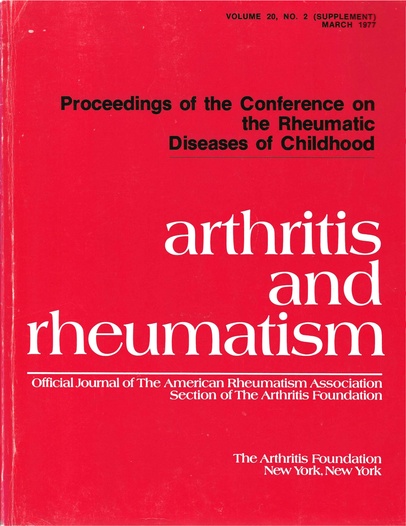
"I think I saw it arrive, although I cannot specify its birthday or place and I am damned if I can read the father's signature on the birth certificate. We are very fortunately a small enough group to know each other personally and to cooperate and enjoy each other's company." Eric Bywaters, at the founding meeting of the Pediatric Rheumatology subspecialty.
"In the beginning we were a handful of naïve but eager and explorative, young physicians of disparate training, background, and temperament. We joined together with a vision of doing whatever was necessary to find better ways to study the rheumatic diseases of childhood and adolescence, and to treat our patients more effectively in a comprehensive continuum of care."
Dr. Earl Brewer and Dr. Joseph Levinson
Foreword, Textbook of Pediatric Rheumatology (2005)
Pioneers of Pediatric Rheumatology
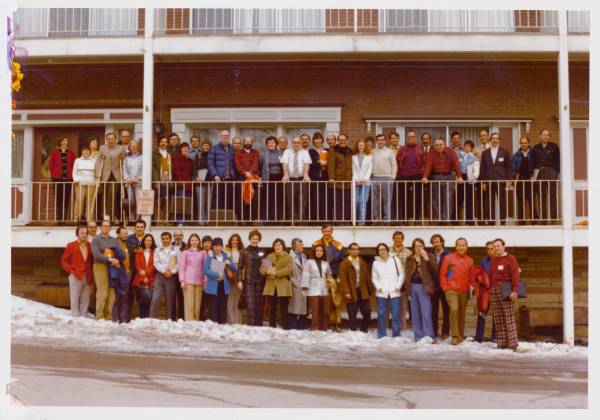
James T. Cassidy, MD
(pictured 12th from left, top row)
Widely regarded as the “father of pediatric rheumatology,” Dr. James T. Cassidy helped establish pediatric rheumatology as a recognized subspecialty and shaped generations of clinicians through his leadership, teaching, and research. He authored the influential Textbook of Pediatric Rheumatology, which became a defining reference in the field, and published hundreds of scientific papers advancing the understanding and treatment of pediatric rheumatic diseases.
Beyond academic medicine, Dr. Cassidy championed education, mentorship, and patient-centered care. His legacy continues through initiatives including the James T. Cassidy Award, the Cassidy Conference, and Camp Jambalaya for children with rheumatic illnesses.
Virgil Hanson, MD
(pictured 21st from left, top row)
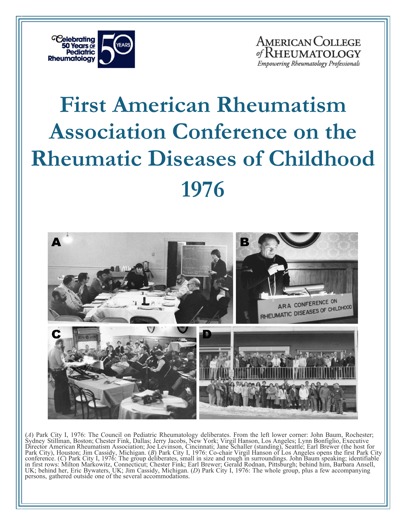
Dr. Virgil Hanson was a leading figure in pediatric rheumatology and helped advance the specialty in the United States. Alongside Dr. Jane Green Schaller, he co-chaired the first American Rheumatism Association Conference on the Rheumatic Diseases of Childhood in Park City, Utah, in 1976 — a landmark event in the recognition of pediatric rheumatology as a subspecialty. His work helped strengthen collaboration, clinical care, and education within the field.
James Sydney Stillman, MD
(not pictured)
Although not formally trained in pediatrics, Dr. James Sydney Stillman became an internationally recognized pioneer in juvenile rheumatoid arthritis. He established the first comprehensive multidisciplinary center for pediatric rheumatic disease in the United States at Boston’s Robert Breck Brigham Hospital and authored more than 60 publications advancing the field. His advocacy efforts helped lead to the Arthritis Act of 1976 and the establishment of the National Institute of Arthritis.
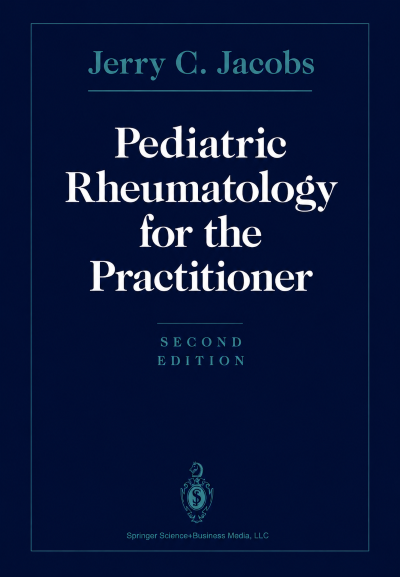
Jerry C. Jacobs, MD
(pictured 7th from left, bottom row)
Dr. Jerry C. Jacobs was a leading pediatric rheumatologist, educator, and international lecturer specializing in pediatric rheumatoid arthritis and connective tissue diseases in children. A professor of clinical pediatrics at Columbia University, he directed the pediatric rheumatology section and Regional Arthritis Program for Children (RAP for Kids). Dr. Jacobs also authored the textbook Pediatric Rheumatology for the Practitioner.
Chester Fink, MD
(pictured 3rd from left, bottom row)
Dr. Chester Fink was a pioneering pediatric rheumatologist whose career spanned more than four decades. A longtime professor at UT Southwestern Medical Center, he helped train generations of pediatric rheumatologists and established the first pediatric rheumatology clinic in Texas at Scottish Rite Hospital for Children in Dallas. Internationally recognized for his work in juvenile rheumatoid arthritis, Dr. Fink also helped shape the specialty through leadership roles with the American Rheumatism Association’s Council on Pediatric Rheumatology.

Jane Schaller, MD
(pictured 19th from left, top row)
Dr. Jane Green Schaller was a pioneering pediatric rheumatologist and educator who helped lay the foundation for the specialty. Alongside Dr. Virgil Hanson, she co-chaired the first American Rheumatism Association Conference on the Rheumatic Diseases of Childhood in Park City, Utah, in 1976. A longtime faculty member at the University of Washington and later Tufts University School of Medicine, Dr. Schaller was widely recognized for her contributions to pediatric medicine, rheumatology, and child advocacy.
Read Dr. Schaller's article: The History of Pediatric Rheumatology →
Rooted in Purpose: The Evolution of Pediatric Rheumatology
1897
A New Understanding of Childhood Arthritis Emerges
In a landmark publication, Sir George Frederic Still described a form of arthritis unique to children, challenging the prevailing belief that children’s diseases simply mirrored those of adults. His observations would later help shape the foundations of pediatric rheumatology.
Early–Mid 1900s
Advances in Immunology Begin Transforming Rheumatic Disease Research
While rheumatic fever remained the primary focus of childhood rheumatic disease research, breakthroughs in immunology — including the identification of rheumatoid factor, LE cells, and antinuclear antibodies — helped establish the scientific foundations for modern pediatric rheumatology and the evolving understanding of autoimmune disease.
1940s
Childhood Rheumatic Diseases Gain Greater Recognition
Physicians increasingly recognized that children with arthritis, lupus, and related rheumatic diseases often presented differently than adults. This growing awareness helped shift attention beyond rheumatic fever and advanced the development of specialized pediatric care.
Late 1940s–1950s
Pediatric Rheumatology Begins Emerging as a Distinct Specialty
Following World War II, growing recognition of juvenile rheumatoid arthritis, childhood lupus, juvenile dermatomyositis, and childhood scleroderma helped shape pediatric rheumatology into an emerging specialty. Although many physicians still believed childhood and adult rheumatoid arthritis were fundamentally the same disease, clinicians increasingly recognized important differences in how rheumatic diseases presented in children.
1960s–1970s
Pediatric Rheumatology Becomes an Organized Specialty
Rapid advances in immunology and genetics transformed the understanding of autoimmune disease, while pediatric rheumatologists increasingly collaborated with specialists across disciplines to improve care for children with rheumatic conditions.
During this period, leaders in the field established the first classification criteria for juvenile rheumatoid arthritis, organized collaborative pediatric research efforts, and advocated for formal recognition within the American Rheumatism Association.
The movement culminated in the landmark 1976 Conference on the Rheumatic Diseases of Childhood in Park City, Utah — widely regarded as the true beginning of organized pediatric rheumatology.
1977
International Collaboration Accelerates Pediatric Rheumatology Research
Collaborative pediatric research efforts expanded rapidly as physicians established standardized approaches for studying the safety and effectiveness of therapies for children with rheumatic disease. International partnerships also grew, including a landmark workshop in Oslo, Norway, that helped unite emerging pediatric rheumatology leaders across Europe.
1980s–1990s
Pediatric Rheumatology Gains Global Recognition
During the 1980s and 1990s, pediatric rheumatology became increasingly organized worldwide through expanded specialty training programs, professional societies, and improved diagnostic and classification systems.
Major milestones included the creation of the American Academy of Pediatrics Section on Rheumatology, the first pediatric rheumatology board certification examination, and the formal recognition of pediatric rheumatology as a subspecialty in 1991.
2000s
Research Networks and Scientific Advances Transform the Field
The early 2000s marked a period of rapid growth in clinical research, collaboration, and scientific discovery. Organizations such as the Childhood Arthritis and Rheumatology Research Alliance (CARRA) strengthened multicenter research efforts and expanded opportunities for clinical trials and data sharing.
By this period, pediatric rheumatology had evolved into a highly organized specialty shaped by major advances in immunology, genetics, and targeted therapies — transforming care for children with chronic rheumatic disease.
Branching Out: Where We Are Today
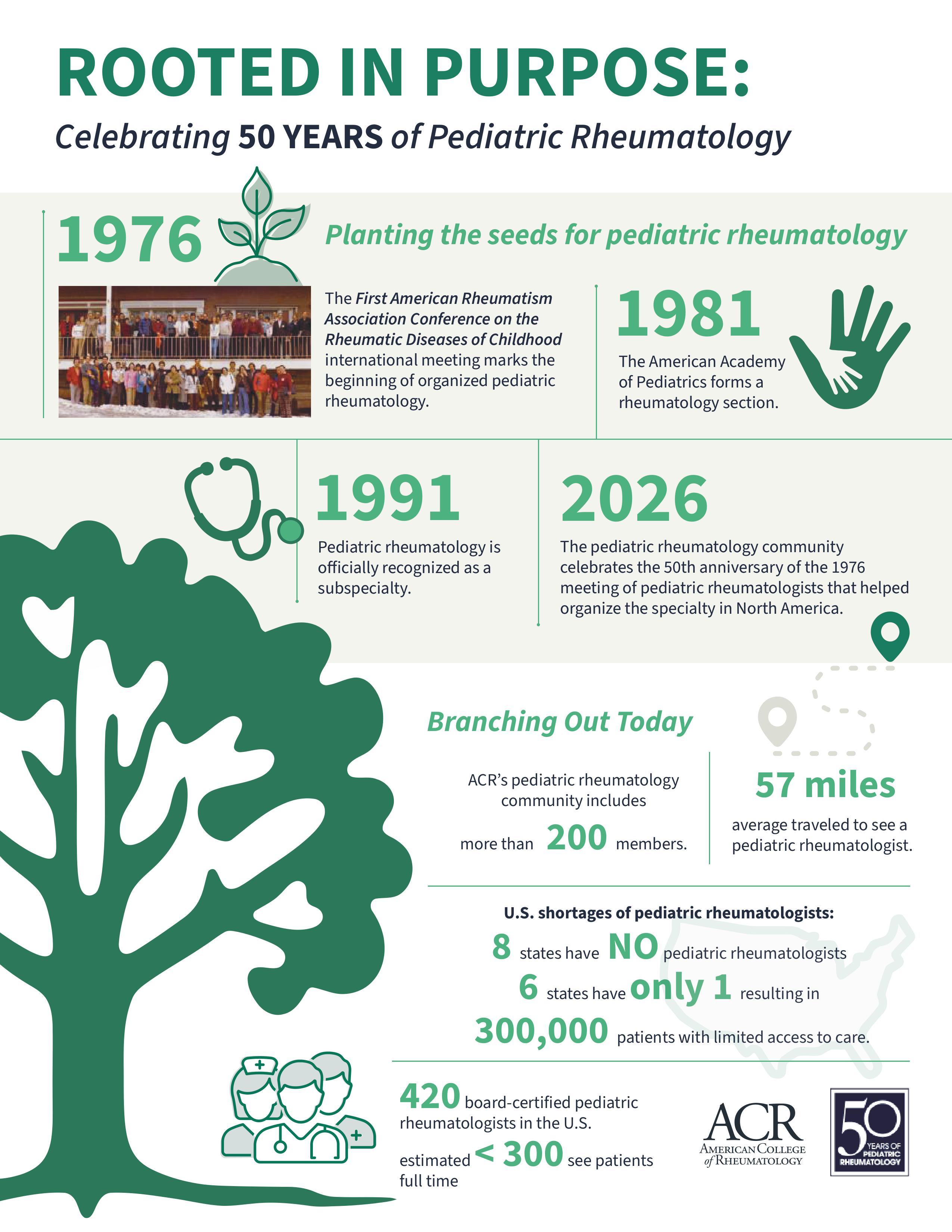
Pediatric rheumatology has evolved into a highly specialized field advancing research, education, and patient care for children with rheumatic disease. Yet workforce shortages and geographic disparities continue to limit access to care — underscoring the ongoing need for advocacy, innovation, and physician recruitment nationwide.
Voices from the Specialty
Hear reflections on the evolution of pediatric rheumatology and the community shaping its future.
Reflections on 50 years of pediatric rheumatology.
Efforts & Policy Solutions
The American College of Rheumatology is pursuing workforce initiatives that focus on pipeline outreach, mentorship, and research on barriers to entering the field.
Proposed strategies include financial incentives (such as loan repayment and improved reimbursement), flexible training models, telehealth expansion, better geographic placement, and strengthened academic positions to ensure every pediatric training program has access to pediatric rheumatology teaching.