April 23, 2026
The Rheum Advocate

This issue of The Rheum Advocate highlights key advocacy wins, practice resources, and policy updates impacting rheumatology.
In This Issue
- Over 130 Advocates Unite in D.C. to Champion Rheumatology Priorities
- ACR Tools to Help You Run a Stronger, More Efficient Practice
- ACR Pushes Solutions as Rheumatology Workforce Shortage Gains National Attention
- Art Meets Advocacy at RheumPAC’s Virtual Paint and Sip
- New Virginia Law Delivers Key Wins for ACR Members Facing Downcoding Challenges
- 2026 NYSRS Spring Meeting Heads to New York City May 15–16
Over 130 Advocates Unite in D.C. to Champion Rheumatology Priorities
On June 2, more than 130 ACR leaders, members, fellows, and patients will gather in Washington, D.C., for the 2026 Rheum Advocacy Conference to bring the voice of rheumatology directly to Capitol Hill.
At a time when the health policy landscape is rapidly shifting, this year’s conference carries added urgency. Advocates will unite to educate lawmakers on the most pressing issues facing the specialty.
Before meeting with members of Congress, participants will take part in comprehensive advocacy training covering the current political environment and the key components of ACR’s policy agenda. Fellows in Training (FITs) will also participate in Advocacy 101; a dedicated program designed to introduce emerging physicians to advocacy and empower them to take an active role in shaping health policy.
This year’s legislative priorities reflect the real-world challenges facing rheumatology, including long-overdue reforms to Medicare physician reimbursement, continued momentum on pharmacy benefit manager (PBM) reform, and urging Congress to support state implementation of new Medicaid requirements through good faith waivers.
Get Involved!
The ACR welcomes general members to apply to attend the Rheum Advocacy Conference. Fellows, general ACR/ARP members, and FITs interested in participating in the 2027 Rheum Advocacy Conference should bookmark the Attend Advocacy Events page or sign up for email alerts to be notified when applications open later this year.

ACR Tools to Help You Run a Stronger, More Efficient Practice
The ACR is here to help rheumatologists and their teams stay ahead of shifting payer policies, evolving reimbursement models, and growing regulatory demands. Explore our latest member tools and programs designed to strengthen your practice’s efficiency, compliance, and financial performance.
Key Resources for Your Practice
Evaluation & Management Chart Auditing
Protect your practice from compliance risks. ACR-certified auditors help identify documentation gaps and coding errors before an external audit occurs. Contact our team at practice@rheumatology.org.
Insurance Template Letters
Access ready-made templates to support appropriate coverage and reimbursement for rheumatology care.
The Business Side of Rheumatology
Coming soon! This updated manual offers practical guidance for launching, managing, and growing a rheumatology practice.
Rheumatology Coding Manual
Your go-to reference for common rheumatology billing codes—ideal for new staff training or quick lookups. Note: This is a members-only resource.
Certified Rheumatology Coder (CRHC) Course & Exam
Build coding expertise through ACR’s specialized education program for coders, billers, and office managers.
Practice Innovation Summit
Join the ACR Practice Management and Education teams for a full-day program on November 6 during ACR Convergence in Orlando, Florida.
Registration opens soon!
New ACR on Air Podcast Episode: Support for Private Practice
Private rheumatology practices face mounting pressure, including shrinking margins, rising prior authorizations, tighter PBM and payer restrictions, and unstable revenue, just as demand, wait times, and workforce shortages grow, fueling burnout and retention challenges. This episode explores how the ACR is stepping up through advocacy, policy reform, and workforce development to help practices move from survival to sustainable growth.
The ACR remains committed to advancing the skills, resources, and education your practice needs to thrive in today’s complex healthcare landscape. Contact our team at practice@rheumatology.org for any assistance.
ACR Pushes Solutions as Rheumatology Workforce Shortage Gains National Attention
Recent NBC Nightly News coverage of the nationwide rheumatology workforce shortage featuring ACR member Dr. Dan Battafarano and ACR research, highlights a challenge rheumatologists see every day – patients waiting months for care or traveling long distances for treatment.
The ACR is using data to educate policymakers, media, and the public on how workforce shortages impact access to timely, effective care, strengthening the case for meaningful policy change.
The College continues to advocate for solutions that support members and expand patient access, including increased funding for fellowship positions, innovative training pathways to reach rural and underserved areas, and policies that address payment, telehealth, and regulatory barriers contributing to burnout and shortages.
The crisis is especially acute in pediatric rheumatology, as highlighted in a recent Healio article by the Chair of ACR’s Committee on Pediatric Rheumatology, Ekemini Ogbu, MD, MSc. She points out that the ACR is pushing for stronger investments in loan repayment programs, expanded GME funding for children’s hospitals, and policies that support teaching and research to grow the next generation of pediatric rheumatologists.
The ACR remains committed to advancing solutions that strengthen the workforce—so patients nationwide can access timely, expert care close to home.
Art Meets Advocacy at RheumPAC’s Virtual Paint and Sip
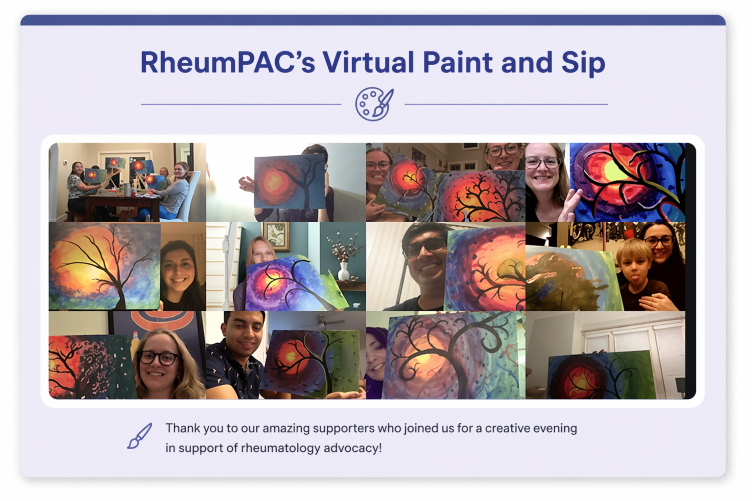
The Rheumatology Political Action Committee (RheumPAC) brought members together for a creative and engaging evening during its recent virtual Paint and Sip fundraiser, blending advocacy with artistry.
Almost 40 participants joined the event, including 10 Fellows in Training (FITs) whose attendance was generously sponsored by program directors and ACR members. The strong FIT participation highlights a growing commitment among early-career rheumatology professionals to engage in advocacy efforts that shape the future of the specialty.
ACR President William Harvey, MD, MSc, FACR, made a special appearance, sharing insights on the critical role of advocacy in advancing rheumatologic care. He emphasized how RheumPAC supports policies that strengthen the profession and ensure patients have access to high-quality care, underscoring the importance of continued member engagement and support.
The event provided a relaxed, interactive setting for attendees to connect with colleagues, learn more about RheumPAC’s impact and contribute to its ongoing efforts, all while creating their own works of art.
Every contribution helps amplify the voice of rheumatology on Capitol Hill. Interested in supporting RheumPAC’s mission?
New Virginia Law Delivers Key Wins for ACR Members Facing Downcoding Challenges
Virginia Governor Abigail Spanberger (D) has signed SB164 into law, advancing protections that directly benefit ACR members and their practices. The legislation addresses insurer downcoding—a persistent issue for rheumatologists, particularly those in independent practice who manage complex conditions requiring extensive documentation.
SB164 introduces new accountability measures for insurers, including requirements to clearly justify any downcoded claim and disclose the rationale and methodology used. Payers must also ensure that downcoded claims are reviewed either by a qualified individual or by systems capable of fully evaluating physician documentation. Importantly, all disputes must be reviewed and decided by a human reviewer, limiting overreliance on algorithms and artificial intelligence.
What This Means for ACR Members
This new law delivers tangible benefits for rheumatology practices across Virginia:
- Members will receive clear notification and explanations when claims are downcoded, reducing uncertainty and improving visibility into payer decisions.
- Clearer processes and accountability standards may decrease the volume of downcoded claims and streamline appeals, saving valuable staff time.
- Defined expectations for payer behavior support more consistent and reliable payment, helping practices plan and operate more effectively.
ACR Advocacy in Action
SB164 reflects ACR’s ongoing commitment to advocating for policies that protect rheumatology practices and patient access to care. By addressing downcoding, this law helps safeguard the financial stability of practices and reinforces the value of physician expertise in coding and documentation.
What’s Next
ACR will continue to monitor how SB164 is implemented and its real-world impact on members. Feedback from Virginia-based members will be essential in shaping future advocacy efforts and ensuring that payer practices continue to improve. The ACR is committed to continuing to collaborate with our partners to address this critical issue that threatens the viability of independent practice.
2026 NYSRS Spring Meeting Heads to New York City May 15–16
Don’t miss the 2026 New York State Rheumatology Society (NYSRS) Spring Meeting, taking place May 15–16 at the InterContinental New York Times Square! Join colleagues from across the region for two days of engaging sessions, networking, and the latest updates in rheumatology. Secure your spot today by registering online.