
June 18, 2026
The Rheum Advocate

Explore how more than 100 rheumatology advocates made their voices heard in Washington, D.C., along with timely updates on federal policies, member resources, and legislative developments that could have a lasting impact on rheumatology practice and patient care.
In This Issue
- Over 100 Rheumatology Advocates Bring Unified Voice to Capitol Hill
- The Business Side of Rheumatology Practice Manual - Free for Members for a Limited Time!
- Take Action to Protect Medicare Part B Access to Complex Rheumatology Therapies
- GOP Doctors Caucus Backs Fix for “Underwater” Biosimilars
- New Medicaid Work Rule Narrows “Medical Frailty” Raising Red Flags for Rheumatology Care
Over 100 Rheumatology Advocates Bring Unified Voice to Capitol Hill
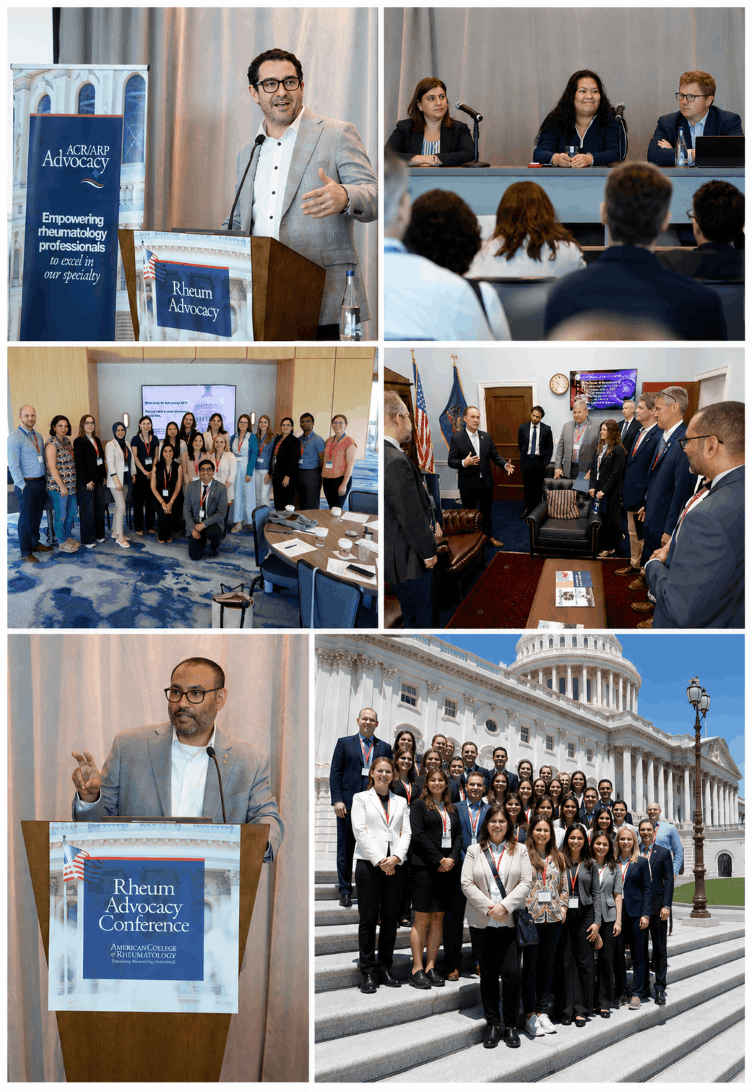
Earlier this month, 114 ACR leaders, rheumatologists, Fellows in Training (FITs), and patient advocates from 33 states and the District of Columbia convened in Washington, D.C., for the 2026 Rheum Advocacy Conference. Together, they held 133 meetings with lawmakers and congressional staff, amplifying the needs of the rheumatology community on Capitol Hill.
During these meetings, advocates urged Congress to make treatments more affordable by protecting physician reimbursement and expanding PBM reforms.
Take action on PBM reform:
Add your voice!
Check out the ACR's Issue Brief
Advocates urged Congress to protect patient access to Medicare by fixing the broken physician reimbursement system.
Take action on Medicare reimbursement:
Add your voice!
Check out the ACR’s Issue Brief
Advocates urged Congress to protect access to care by encouraging the granting of "good faith" exemptions for new federal Medicaid requirements.
Take action on Medicaid protections:
Add your voice!
Check out the ACR’s Issue Brief
Before heading to the Hill, attendees heard from policy experts, including David Burt of the PACT Coalition, as well as staff from both the Republican and Democratic Doctors’ Caucuses (pictured below). These sessions provided key insights into the current legislative landscape and equipped participants with the tools to advocate effectively.
Preparing the Next Generation of Advocates
Fellows in training and patient advocates participated in dedicated programming designed to strengthen their advocacy skills. A select group of FITs took part in Advocacy 101 (pictured below), a half-day intensive covering the fundamentals of government and ACR advocacy efforts.
Stay Engaged Year-Round
- Interested in attending next year’s Rheum Advocacy Conference? Stay up to date when applications launch →
- Contact your lawmakers through the Legislative Action Center.
- Support RheumPAC and invest in the future of rheumatology.
- Sign up to write a Letter to the Editor (LTE) in your local paper that will help raise awareness about issues facing rheumatologists and patients by emailing pr@rheumatology.org.
- Email advocacy@rheumatology.org to get involved!

The Business Side of Rheumatology Practice Manual – Free for Members for a Limited Time!
Are you contemplating starting a rheumatology practice or seeking guidance on making improvements in your current practice? Gain in-depth knowledge on practical, tangible ways to build and run a successful practice with the ACR’s newly updated Business Side of Rheumatology Practice manual.
The manual is a thorough resource that reflects today’s real-world challenges and provides direction and solutions for rheumatology private practices. It contains tips for staffing models, help with making critical decisions regarding in-office infusion services and legal resources, direction on how to choose the right EHR system, expert advice on marketing and human resources, and more.
Pricing
- Members: Free through August 31 with discount code at checkout: “Member Discount BOM” (increases to $499 on September 1)
- Nonmembers: $549
Login and get your copy today!
Take Action to Protect Medicare Part B Access to Complex Rheumatology Therapies
The ACR and the Coalition of State Rheumatology Organizations (CSRO) are urging rheumatology professionals to support the Protecting Patient Access to Cancer and Complex Therapies Act (H.R. 4299), a bipartisan bill that would stabilize Medicare Part B drug reimbursement and protect access to community-based infusion and injection services for patients with complex rheumatic diseases.
Key Protections for Rheumatology Care
Without this fix, upcoming changes tied to the Medicare Drug Price Negotiation Program could cut Part B reimbursement for selected drugs by an estimated 40–60% starting in 2028, threatening the viability of in-office infusion, especially in community and rural settings, and ultimately jeopardizing timely patient access to critical therapies.
H.R. 4299 would keep provider payment at 106% of Average Sales Price (ASP) for selected Part B drugs while still allowing Medicare and patients to benefit from lower negotiated “Maximum Fair Price” (MFP) levels, ensuring savings come from manufacturer rebates rather than reductions in physician reimbursement.
How You Can Take Action
ACR and CSRO are collaborating with a broad coalition of physician and patient organizations to advance this legislation, and they need rheumatology professionals to add their voices. You can take action now by signing the joint advocacy letter urging your senators and representatives to cosponsor H.R. 4299. Complete this form to add your name today!
GOP Doctors Caucus Backs Fix for “Underwater” Biosimilars
Members of the GOP Doctors Caucus have formally urged the U.S. Department of Health and Human Services (HHS) to address the ongoing problem of “underwater” biosimilars in Medicare. In their letter, the physician–lawmakers call on HHS to fix payment policies that reimburse certain infused biosimilars below practices’ acquisition costs, leaving clinicians effectively underwater each time they provide these therapies to patients.
This advocacy from the Doctors Caucus is an encouraging sign that congressional attention to the biosimilars market and its impact on patient access and practice sustainability is growing. A policy remedy that corrects underwater reimbursement would help support continued use of lower-cost biosimilars in rheumatology and other specialties, allowing practices to confidently offer these treatments while helping patients and payers realize the intended savings.
The ACR will continue to monitor HHS’s response to the letter and work with partners on Capitol Hill and within the administration to advance a solution that protects patient access to biologic and biosimilar therapies.
New Medicaid Work Rule Narrows “Medical Frailty” Raising Red Flags for Rheumatology Care
On June 1, CMS released an interim final rule (IFR) outlining how states must implement the OBBBA’s Medicaid work and community engagement requirements, with states generally required to comply by January 1, 2027, unless granted an exemption. The rule explains who must meet work/engagement standards, how “medically frail” enrollees may qualify for exemption, verification processes, good-faith implementation extensions for states, and estimated state costs.
The statute exempts “medically frail” individuals from work requirements, including people who are blind or disabled; have a substance use disorder; have a disabling mental disorder; have a physical, intellectual, or developmental disability that significantly impairs activities of daily living; or have a serious or complex medical condition. The IFR tightens this framework by requiring that, in addition to meeting one of these categories, beneficiaries must also have an impaired “ability to comply with the community engagement requirement” as a result of their condition—a narrower standard than what many stakeholders expected and one that may be difficult to apply consistently in practice.
Through January 1, 2028, states may verify medical frailty using third party documentation or sworn self attestation, but after that point they may accept self attestation only once during an enrollment period and must rely on state data or clinical documentation to confirm ongoing eligibility for the exemption.
What This Means for Rheumatology Professionals
For rheumatology practices, especially those serving large numbers of Medicaid beneficiaries, the narrower medical frailty standard and tighter verification rules could translate into more administrative work and greater risk of coverage disruptions for clinically vulnerable patients. Clinicians may be asked more frequently to provide detailed documentation that a patient’s rheumatic disease both meets the “serious or complex medical condition” category and directly impairs their ability to comply with 80 hours per month of work, education, or community engagement activities.
Rheumatology professionals may need to proactively build workflows that flag patients likely to qualify for medical frailty, incorporate functional status and work-capacity information into documentation, and coordinate with care managers and legal advocates to avoid unnecessary coverage loss.
What This Means for Rheumatology Patients
For patients living with serious rheumatic diseases, Medicaid coverage can be critical to maintaining mobility, managing chronic pain, and preventing irreversible joint damage. Narrower medical frailty criteria, combined with stricter verification and reporting requirements, increase the risk that eligible patients may lose coverage—not because they are ineligible, but because they cannot navigate complex paperwork, meet documentation demands, or consistently demonstrate their ability (or inability) to work in the face of fluctuating symptoms.
The interim final rule is open for public comment until July 31, offering rheumatology clinicians, practices, and patient advocates an opportunity to highlight how the new standards could uniquely impact people with chronic, fluctuating rheumatic diseases and to urge CMS to adopt safeguards that protect continuous coverage and access to care.